Playable solitaire
Pyramid
Pyramid Solitaire is a pairing game, not a building cascade. Twenty-eight cards form a pyramid of seven rows; a card is free when no cards overlap it from below. Remove two free cards whose ranks sum to 13, or remove a free King by itself. Remaining cards sit in the stock; draw to the waste and pair the waste top with a free pyramid card (or remove a King from waste when free under the same rules).
SolitaireVP allows two redeals: when the stock is empty you may recycle the waste back into the stock twice. Clear every pyramid card to win — leftover stock after a cleared pyramid is fine; buried pyramid cards are not.
From New game you can also choose a shuffle style — Random, Winnable, Easy, Medium, or Hard — when you want the next deal to feel more open-ended or more guided.
How to play Pyramid
- Only uncovered (free) pyramid cards and the top waste card are playable.
- Pair two free cards that sum to 13 (e.g. Ace+Queen, 2+Jack, 3+10, 4+9, 5+8, 6+7; Queen=12, Jack=11, Ace=1).
- Remove a free King alone (Kings count as 13).
- Draw from the stock to the waste when you need new partners.
- When the stock empties, recycle the waste — up to two redeals.
- Clear all 28 pyramid cards to win.
Setup
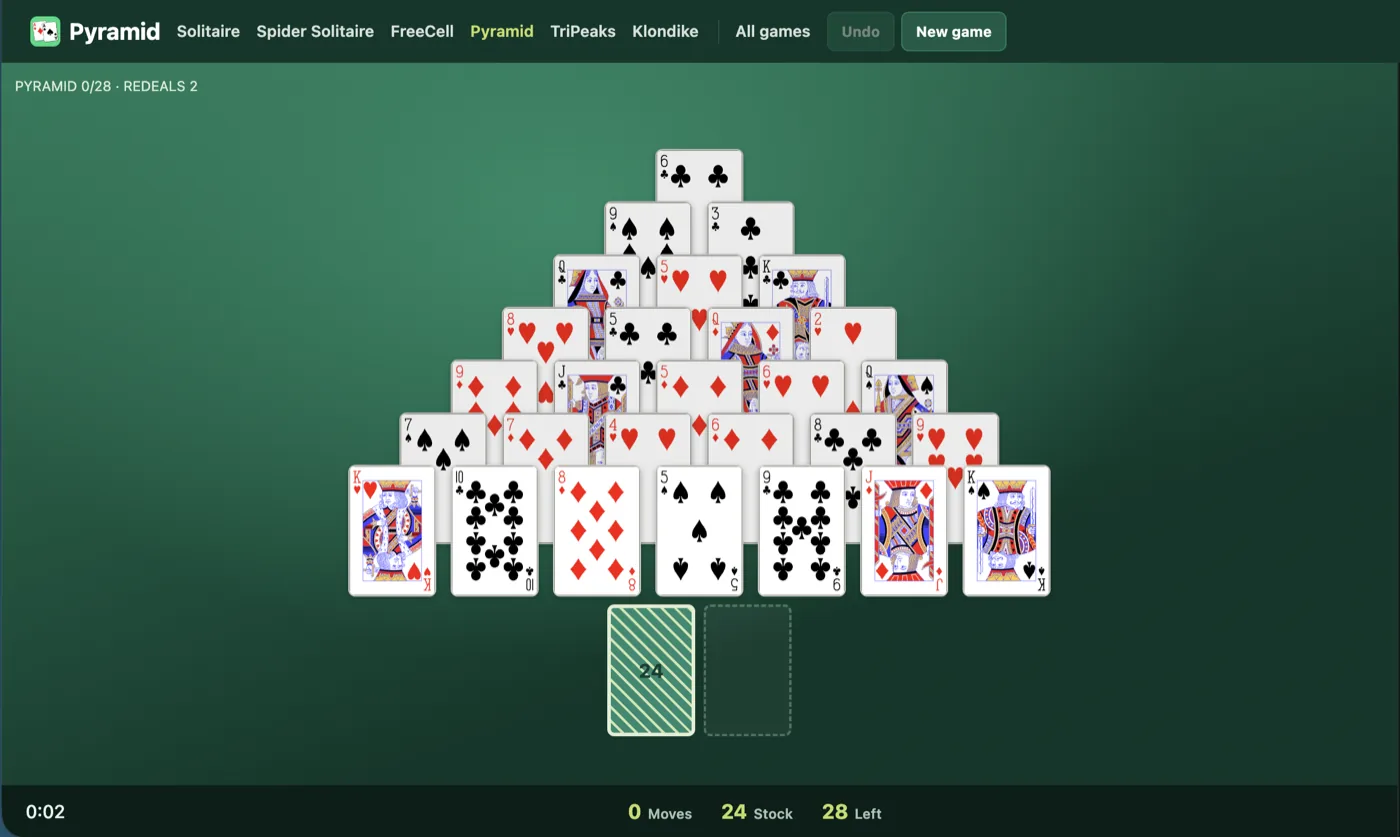
- Pyramid: 28 cards in rows of 1 through 7; lower cards cover the ones above.
- Stock: the other 24 cards.
- Waste: empty at the start.
- Discard / removal pile: where paired cards and Kings go (not suit foundations).
Rules
- Pair ranks that sum to 13; Kings remove solo.
- A pyramid card is free only when both cards covering it are gone.
- Waste top may pair with a free pyramid card or be a solo King removal.
- Max redeals: 2 (then no further recycle).
- Win by emptying the pyramid (all 28 slots cleared).
Strategy
Pyramid is about not stranding mid-pyramid cards behind the wrong partners.
- Clear the base row thoughtfully — every removal unlocks parents above.
- Don’t waste Kings without checking whether a pairing elsewhere unlocks more.
- Save redeals for when the waste order is truly stuck.
- Watch for mutual blockers: two needed partners both buried under each other’s covers.
- Prefer removals that free two new cards over ones that free none.
- Peek at upcoming stock with careful draws; use Undo to test a recycle timing.
Short prose: count thirteens on the exposed edge before you draw. Often the right play is already on the pyramid — drawing just digs a deeper waste hole you’ll need a redeal to fix.
FAQ
What pairs sum to 13?
A+Q, 2+J, 3+10, 4+9, 5+8, 6+7. Kings are removed alone. Two cards of the same rank never pair unless they sum to 13 (they don’t).
How many redeals do I get?
Two. After the second recycle, an empty stock stays empty.
Do I have to clear the stock too?
No. Winning means the pyramid is empty. Leftover stock/waste is allowed.
Can I pair two waste cards?
Play uses the waste top with a free pyramid card (or King removal). Focus on pyramid freedom.
Is suit important?
No — only ranks matter for pairing.
Can every deal be won?
Not with a pure Random shuffle. Like a physical deck, some layouts simply have no winning line no matter how carefully you play — and that uncertainty is part of the classic challenge. If you would rather spend your time on strategy than on an unlucky seed, open New game and choose Winnable (or Easy, Medium, or Hard). Those options deal from banks of layouts our engine already rated as more promising, so a loss is more often about the moves you made than about an impossible start.
What do the shuffle options mean?
New game offers five deal styles:
- Random — an unbiased fresh seed. Some hands open beautifully; others are dead ends.
- Winnable — a favorable deal drawn from our curated pool, biased toward layouts with clearer progress paths.
- Easy, Medium, and Hard — the same idea, tilted toward gentler, middling, or tougher opening positions.
Your choice sticks for later New games in that browser until you change it.
Trivia
Pyramid (also called Pyramid Patience) appears in twentieth-century Patience collections as a satisfying “remove pairs” cousin to Golf and TriPeaks. The sum-to-thirteen rule makes Ace and face cards matter as arithmetic, not as suit builders.
Digital Pyramid popularized the neat triangular layout and limited redeals as a difficulty dial. SolitaireVP’s table uses two redeals — enough to recover from a harsh waste order without turning the game into an endless grind.