Spider Solitaire 2 Suits
Playable solitaire
Spider Solitaire 2 Suits
Spider Solitaire 2 Suits on SolitaireVP is the mid-difficulty Spider layout: two decks filtered to spades and hearts (104 cards) dealt across ten tableau columns. There is no waste pile. You build descending sequences in the columns, but only same-suit consecutive runs move as a unit. Deal a fresh row of ten cards from the stock when every column has at least one card, and clear completed King-to-Ace runs onto the foundation slots.
Two-suit Spider adds real suit juggling on top of the empty-column packing puzzle. Mixed-suit stacks are legal to place by rank, but you can only lift a run that stays in one suit — so planning builds and protecting empties matters more than in one-suit Spider.
Clear all eight runs to win. Undo is available; Spider does not use Auto finish.
From New game you can also choose a shuffle style — Random, Winnable, Easy, Medium, or Hard — when you want the next deal to feel more open-ended or more guided.
How to play Spider Solitaire 2 Suits
- Build columns down in rank (King → Queen → … → Ace). Any suit may sit on the next higher rank.
- Move a card or a consecutive same-suit descending run onto a valid target.
- Empty columns accept any card or run — they are your most powerful resource.
- When you need fresh cards, deal a new row: one card onto each of the ten columns. You cannot deal while any column is empty.
- Completing a full King-through-Ace same-suit run removes it automatically to a foundation slot.
- Continue until eight runs are cleared (104 cards).
Setup
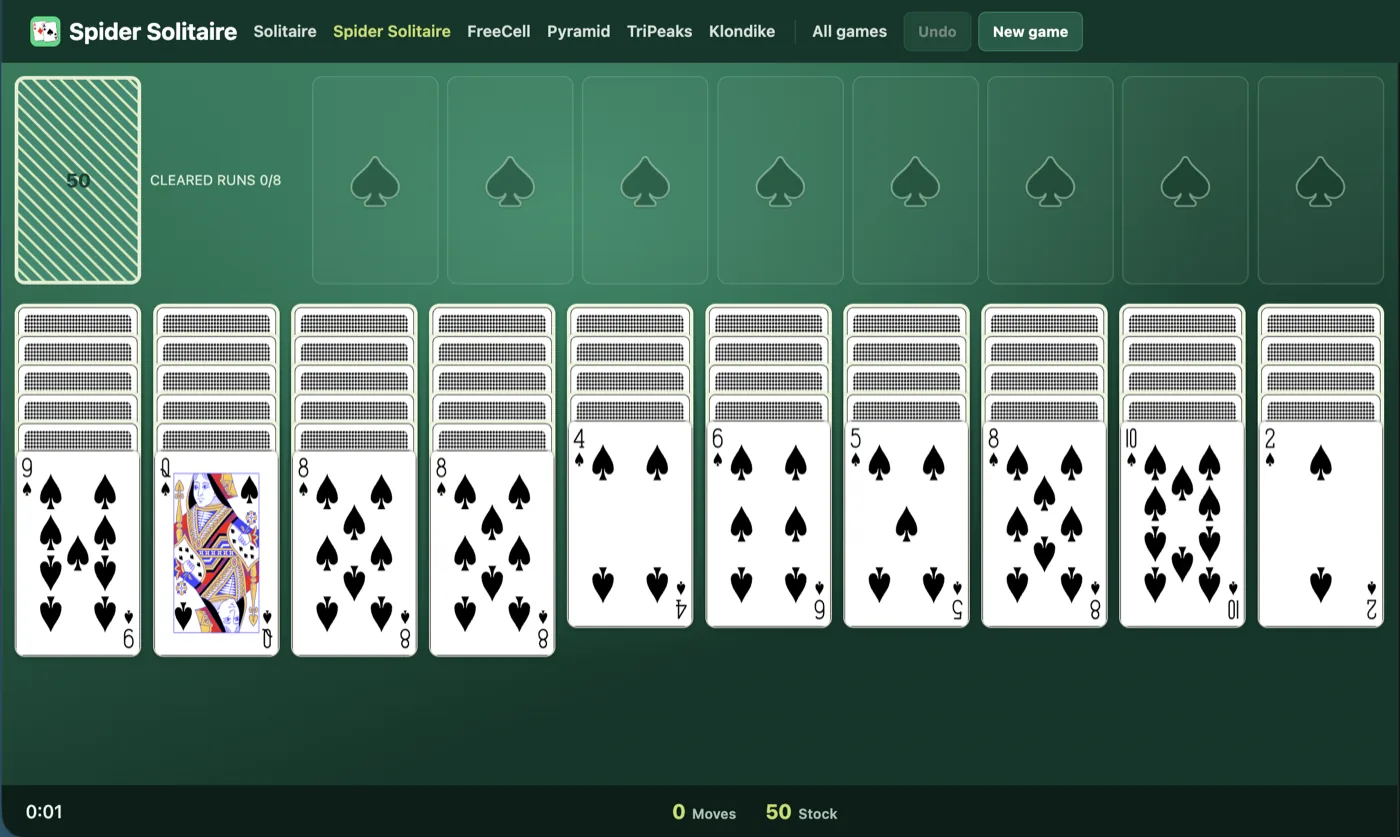
- Deck: 104 cards — four A–K runs each of spades and hearts.
- Tableau: ten columns — four columns of 6 cards and six of 5 (54 cards dealt); each column’s top card face-up.
- Stock: remaining 50 cards, dealt in rows of 10 (five deals).
- Foundations: eight slots that receive completed King-to-Ace runs.
- No waste pile.
Rules
- Two-suit Spider (
spiderSuits: 2); spades and hearts only. - Only consecutive descending same-suit runs move as a unit.
- Placement onto a column requires next-lower rank; suit of the target need not match.
- Empty column: any card allowed.
- Stock deal: ten cards, one per column; blocked if any column is empty.
- No redeals of the stock beyond the fixed row deals.
- Win by clearing eight complete King-to-Ace runs.
Strategy
Empty columns are oxygen. Protect them until a deal is safe, and use them to reassemble long same-suit runs.
- Prefer building in suit so runs stay movable and clearable.
- Don’t bury a suit under the other if you can help it — mixed stacks freeze long lifts.
- Don’t deal early if empties are doing important work — but don’t stall forever with a stuck board either.
- Expose face-down cards before polishing perfect sequences.
- Fill empties carefully before a deal — the deal requires all ten columns occupied.
- Use Undo to test whether a deal helps or wrecks your empties.
Short prose: two-suit Spider is one-suit’s packing problem with a suit tax. Each stock row still adds ten cards; now you must also keep spades and hearts separable enough to finish runs.
FAQ
How many suits are in this version?
Two — spades and hearts. Prefer an easier table? Play one-suit Spider. Want the full grind? Try four-suit Spider.
When can I deal a new row?
Only when every tableau column has at least one card. Empty columns block the deal.
How do I win?
Clear eight complete King-to-Ace runs from the tableau onto the foundation slots.
Is there a waste pile?
No. Cards come from the stock only as full rows onto the ten columns.
Can I undo?
Yes. Undo steps back through the current deal’s history.
Is Auto finish available?
No. Spider clears runs as you complete them; there is no Auto finish control on this family.
Can every deal be won?
Not with a pure Random shuffle. Like a physical deck, some layouts simply have no winning line no matter how carefully you play — and that uncertainty is part of the classic challenge. If you would rather spend your time on strategy than on an unlucky seed, open New game and choose Winnable (or Easy, Medium, or Hard). Those options deal from banks of layouts our engine already rated as more promising, so a loss is more often about the moves you made than about an impossible start.
What do the shuffle options mean?
New game offers five deal styles:
- Random — an unbiased fresh seed. Some hands open beautifully; others are dead ends.
- Winnable — a favorable deal drawn from our curated pool, biased toward layouts with clearer progress paths.
- Easy, Medium, and Hard — the same idea, tilted toward gentler, middling, or tougher opening positions.
Your choice sticks for later New games in that browser until you change it.
Trivia
Microsoft’s Spider Solitaire popularized switching between one, two, and four suits as difficulty tiers. Two-suit sits in the sweet spot: enough suit conflict to punish careless stacks, without the full chaos of four suits. Online, “Spider solitaire 2 suits” remains one of the most searched mid-difficulty Patience layouts.