Forty Thieves
Playable solitaire
Forty Thieves
Forty Thieves (Napoleon at St. Helena, in some books) is a deep two-deck Patience: 104 cards, ten tableau columns dealt four face-up cards each (forty cards — the name’s hint), eight foundations building Ace to King by suit, and a stock of 64 with a waste. You build the tableau down by the same suit only, and you may move one card at a time — no multi-card run moves. Empty columns accept any single card. The stock deals one card at a time to the waste with no redeals: one pass through, then the waste and tableau must finish the job.
This is one of SolitaireVP’s hardest tables — sparse mobility, strict suit matching, and an unforgiving stock. Auto finish is available when the endgame is clear. Undo is essential for serious attempts.
From New game you can also choose a shuffle style — Random, Winnable, Easy, Medium, or Hard — when you want the next deal to feel more open-ended or more guided.
How to play Forty Thieves
- Build eight foundations Ace → King by suit (two decks → two foundations per suit).
- On the tableau, place a card only if it is the same suit and one rank lower than the target top.
- Move one card at a time from tableau or waste (never from foundations).
- Fill empty columns with any single card — they are your main reordering tool.
- Draw one from the stock to the waste when needed; no recycle when the stock empties.
- Get all 104 cards onto foundations to win; use Auto finish when it appears.
Setup
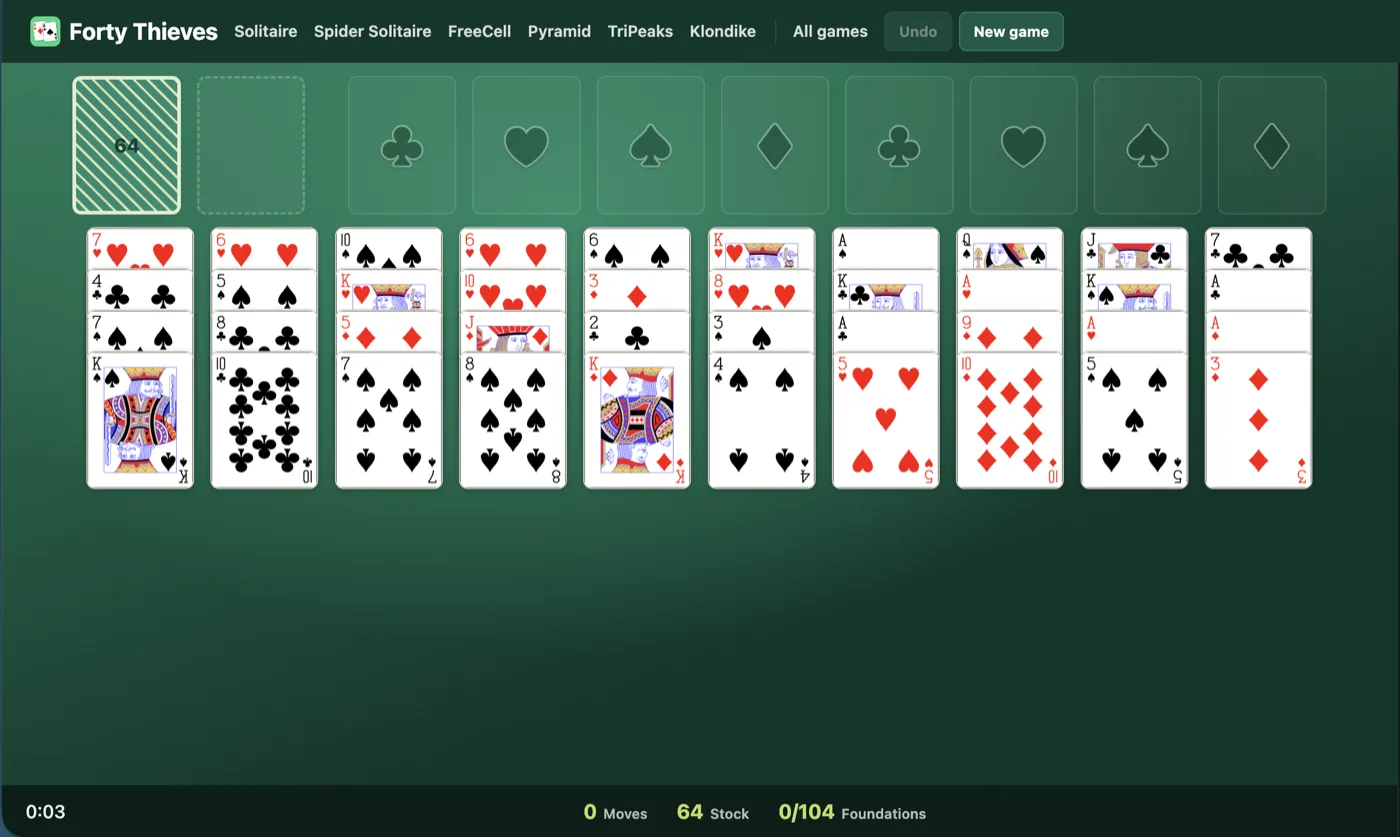
- Tableau: 10 columns × 4 face-up cards (40).
- Stock: 64 cards; draw one; maxRedeals = 0.
- Waste: empty at start.
- Foundations: 8 empty Ace-to-King suit piles.
Rules
- Two decks (104 cards).
- Tableau: build down by same suit; single-card moves only.
- Empty column: any card.
- Foundations: up by suit from Ace; two complete runs per suit possible.
- Stock: one pass, no redeals.
- Cards may not be removed from foundations once placed.
- Win at 104/104 on foundations.
Strategy
Forty Thieves is about empty columns and suit highways.
- Empty columns are everything — use them to unstick same-suit descents.
- Don’t fill an empty too casually; that space may be your only swap buffer.
- Send cards to foundations when they won’t be needed as down-build helpers — but stranding a suit mid-tableau is fatal.
- Track duplicate ranks across two decks; the “second” Ace of a suit needs its own foundation path.
- Be stingy with stock deals until the tableau has no useful single-card plays.
- Expect to Undo often; winning lines are narrow.
Short prose: imagine eight suit ladders and a board that only lets you slide one rung at a time. Creating a blank column is like earning a free hand — spend it to assemble long same-suit descents, then milk them into foundations.
FAQ
Why “Forty” Thieves?
Forty cards are dealt to the tableau (10×4). The rest wait in the stock.
Can I move a whole sequence?
No. Classic Forty Thieves on SolitaireVP allows single-card moves only.
Do I build by alternating color?
No — same suit descending on the tableau.
Can I redeal the stock?
No. One pass only.
May empty columns take any card?
Yes — unlike Klondike’s Kings-only rule.
Is Auto finish available?
Yes, when remaining cards can safely complete on the foundations.
Can every deal be won?
Not with a pure Random shuffle. Like a physical deck, some layouts simply have no winning line no matter how carefully you play — and that uncertainty is part of the classic challenge. If you would rather spend your time on strategy than on an unlucky seed, open New game and choose Winnable (or Easy, Medium, or Hard). Those options deal from banks of layouts our engine already rated as more promising, so a loss is more often about the moves you made than about an impossible start.
What do the shuffle options mean?
New game offers five deal styles:
- Random — an unbiased fresh seed. Some hands open beautifully; others are dead ends.
- Winnable — a favorable deal drawn from our curated pool, biased toward layouts with clearer progress paths.
- Easy, Medium, and Hard — the same idea, tilted toward gentler, middling, or tougher opening positions.
Your choice sticks for later New games in that browser until you change it.
Trivia
Forty Thieves is frequently tied in lore to Napoleon’s exile on St. Helena — hence alternate names like Napoleon at St. Helena — though printed Patience history is murkier than the legend. What is certain is the game’s reputation: a stern two-deck test that separates casual Klondike habits from deliberate suit planning.
Variants relax the rules (moving sequences, limited redeals, Josephine, etc.). SolitaireVP ships the strict classic: same-suit down, one card at a time, no redeals — the version that still feels like cracking a safe when it finally yields.