Playable solitaire
Yukon
Yukon looks like Klondike’s seven-column cousin but plays very differently: there is no stock and no waste. After the deal, every remaining card is already on the tableau — mostly face-up in thick stacks. You may pick up any face-up card and move it together with everything piled on top of it, even if that pile is not a legal alternating sequence. The destination still must follow Klondike-style rules: place onto a next-higher opposite-color card, or put a King into an empty column. Foundations build Ace to King by suit.
That “messy stack move” rule is Yukon’s signature. You rearrange buried face-up cards by sliding whole chunks, flip the few face-down cards when exposed, and work everything home without waiting on a stock. Auto finish is available when the board is ready.
From New game you can also choose a shuffle style — Random, Winnable, Easy, Medium, or Hard — when you want the next deal to feel more open-ended or more guided.
How to play Yukon
- Build foundations up by suit from Ace to King.
- Build tableau targets down by alternating color (same placement rule as Klondike).
- Move any face-up card plus all cards above it as one unit — the moved cards need not be in order among themselves.
- Empty columns accept Kings only (or King-led moved stacks whose bottom card is a King).
- Flip newly exposed face-down cards and continue until foundations are complete.
- Use Undo anytime; Auto finish when offered.
Setup
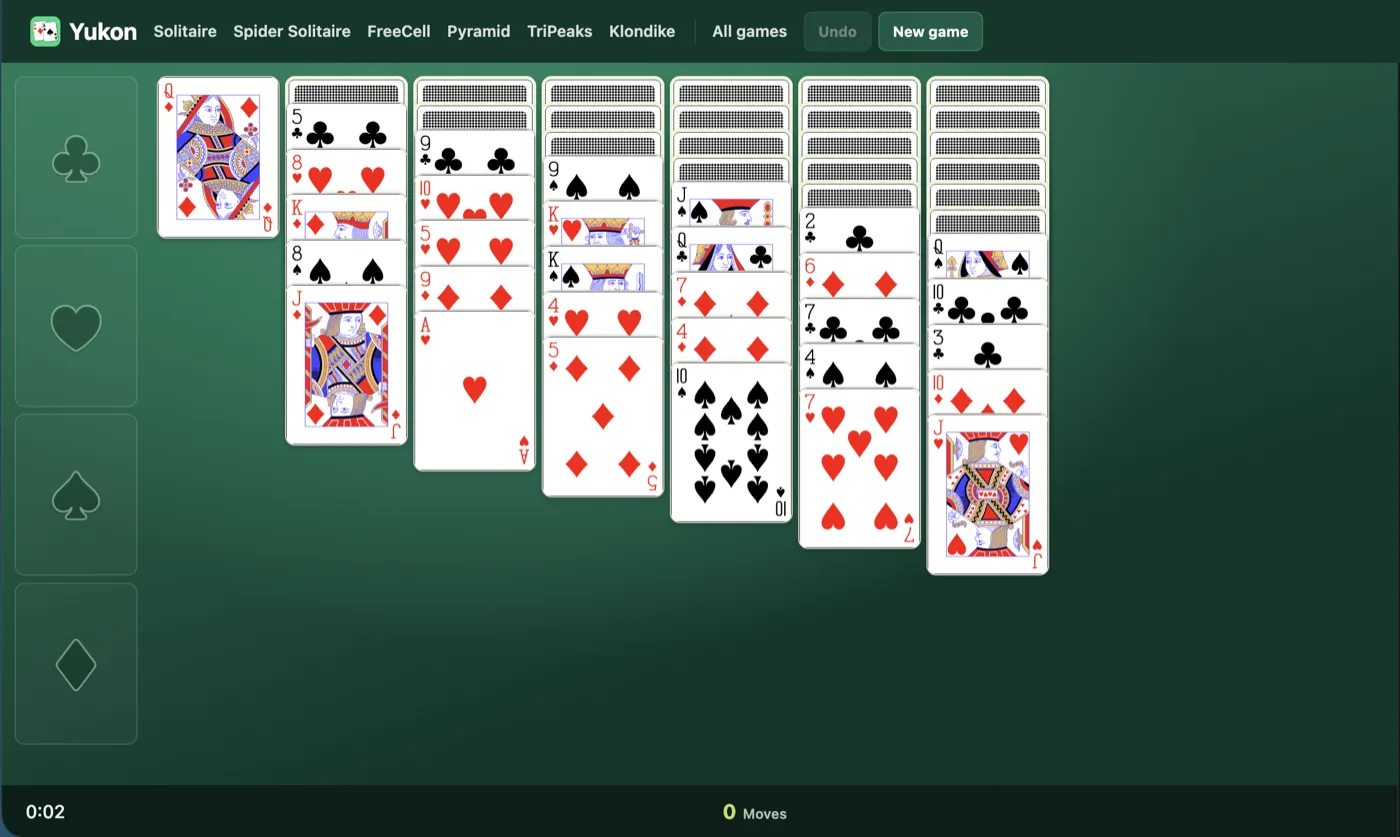
Classic Yukon deal (52 cards, no stock):
- Column 1: 1 face-up card.
- Columns 2–7: Klondike-style base (face-down under a face-up top), then four extra face-up cards on each of columns 2–7.
- Foundations: four empty suit piles.
- Stock / waste: none.
Rules
- One deck; no stock draws or redeals.
- Foundations: Ace → King by suit.
- Tableau placement: descending, alternating color; Kings on empty columns.
- You may move a face-up card with any cards above it (disordered stacks allowed).
- Win when all 52 cards are on foundations.
Strategy
Yukon is about liberation. Face-down cards are few but critical; face-up buried cards can be excavated by moving the stack that sits on them — if you have a legal landing spot for the bottom card of that move.
- Hunt face-down cards — each flip expands your options permanently.
- Don’t fear messy stacks — legality is checked at the destination bottom card, not inside the moving pile.
- Empty columns are King gates — opening one without a King can stall you.
- Build foundations when it frees a key mover, not only when a card “can” go up.
- Keep color flexibility so large chunks still have landing sites.
- Use Undo to try heroic stack shifts that might unblock an Ace.
Short prose: imagine picking up a slice of the column from any face-up depth. If that slice’s bottom card fits the target, the whole slice comes along — chaos on top is fine. That single idea separates Yukon from Klondike.
FAQ
Is there a stock?
No. Yukon deals the whole deck onto the tableau.
Can I move cards that aren’t in sequence?
Yes. The cards above your chosen face-up card move with it even if disordered. The destination must still accept the bottom card of the moving bunch (alternating color, one rank lower — or empty column for a King).
How is Yukon different from Klondike?
No stock, thicker face-up piles, and freer stack moves. Foundations and empty-column King rules feel familiar; mobility does not.
Does Auto finish work?
Yes, when remaining cards can safely complete on the foundations.
Can I undo?
Yes.
Can every deal be won?
Not with a pure Random shuffle. Like a physical deck, some layouts simply have no winning line no matter how carefully you play — and that uncertainty is part of the classic challenge. If you would rather spend your time on strategy than on an unlucky seed, open New game and choose Winnable (or Easy, Medium, or Hard). Those options deal from banks of layouts our engine already rated as more promising, so a loss is more often about the moves you made than about an impossible start.
What do the shuffle options mean?
New game offers five deal styles:
- Random — an unbiased fresh seed. Some hands open beautifully; others are dead ends.
- Winnable — a favorable deal drawn from our curated pool, biased toward layouts with clearer progress paths.
- Easy, Medium, and Hard — the same idea, tilted toward gentler, middling, or tougher opening positions.
Your choice sticks for later New games in that browser until you change it.
Trivia
Yukon is often grouped with Russian Solitaire and related “build and shift” Patience games from the twentieth century. The no-stock deal and permissive stack moves create a wide-open tactical feel that Klondike players find refreshing — less waiting on the waste, more sculpting the board.
Digital Yukon keeps the same romance as the name: a northern cousin of Klondike where everything is already on the table and skill is in how you lift and restack.