FreeCell
Playable solitaire
FreeCell
FreeCell deals the entire deck face-up into eight tableau columns — four columns of seven cards and four of six — with four free cells as single-card buffers and four Ace-to-King suit foundations. There is no stock and no hidden information: every card is visible from the first move.
You build the tableau down by alternating color, foundations up by suit, and use free cells (and empty columns) as temporary storage. How many cards you can move as a sequence depends on open free cells and empty columns — plan cascades like a sliding puzzle. Most deals are solvable with careful play, which is part of FreeCell’s enduring appeal.
Auto finish is available when the remaining foundation path is clear. Undo lets you explore without losing the deal.
From New game you can also choose a shuffle style — Random, Winnable, Easy, Medium, or Hard — when you want the next deal to feel more open-ended or more guided.
How to play FreeCell
- Build foundations Ace → King by suit.
- Build tableau columns down by alternating color.
- Park single cards in any of the four free cells.
- Move ordered alternating sequences when you have enough free cells / empty columns to support the cascade length.
- Empty columns accept any card (not Kings-only).
- Clear all cards to the foundations to win; use Auto finish when it appears.
Setup
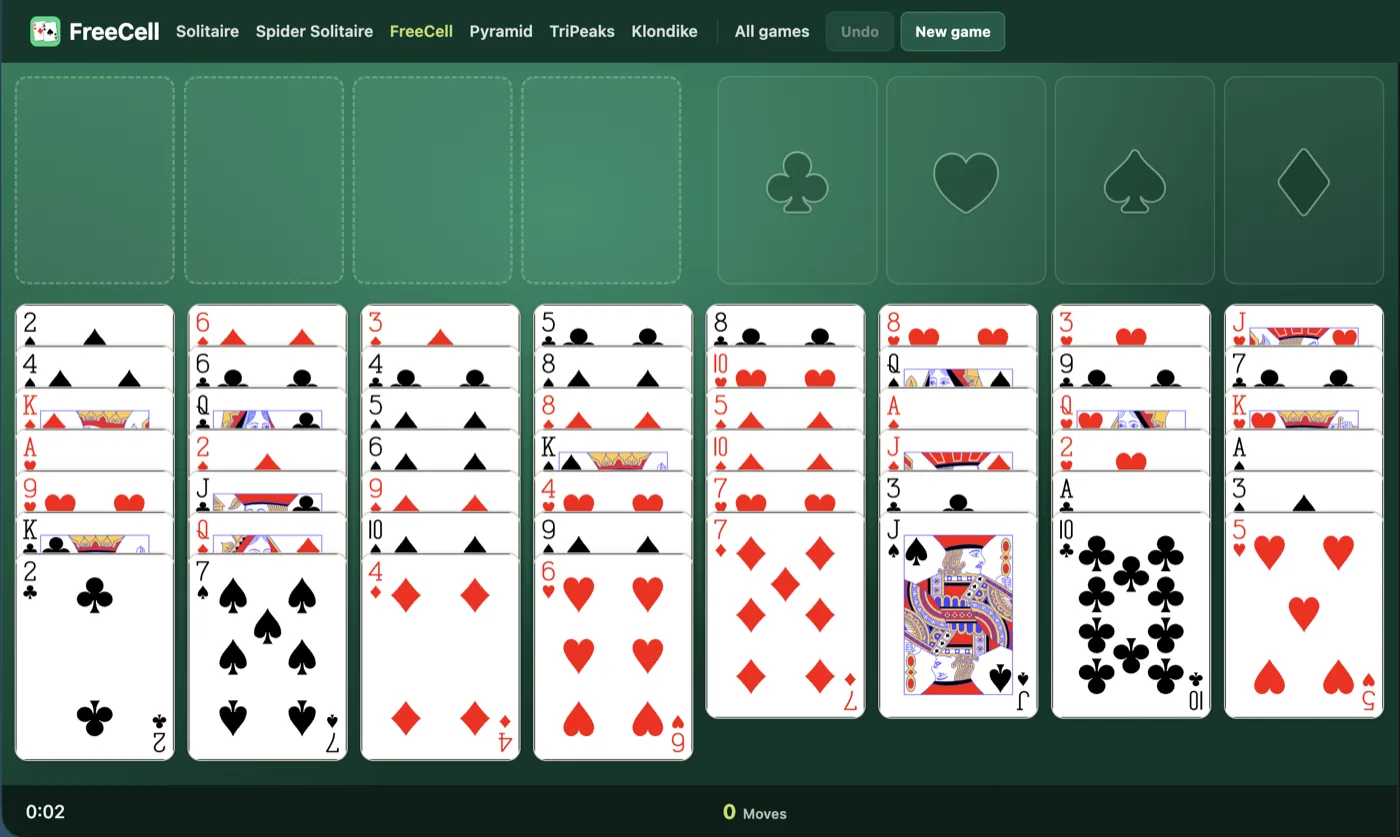
- Tableau: 8 columns, all cards face-up (7+7+7+7+6+6+6+6).
- Free cells: 4 empty single-card holders.
- Foundations: 4 empty suit piles.
- No stock / waste.
Rules
- One deck; all cards dealt at the start.
- Tableau: descending, alternating color.
- Foundations: ascending by suit from Ace.
- Free cells hold at most one card each.
- Empty tableau columns accept any card.
- Sequence moves are limited by available free cells and empty columns.
- No stock redeals (nothing left to deal).
- Win when all four foundations are complete.
Strategy
FreeCell is information-complete — mistakes are usually planning errors, not bad luck.
- Keep free cells open. Filling all four early is a common trap.
- Empty columns multiply your move power — treat them as super free cells.
- Don’t bury Aces and Deuces under long builds if a free cell can liberate them.
- Build foundations evenly enough that you don’t strand high cards of another suit.
- Prefer moves that increase mobility (free a cell, open a column) over cosmetic tidy-ups.
- Use Undo to verify a long cascade before committing mentally to a dead end.
Short prose: think two or three moves ahead about where a blocking card will go. FreeCell rewards leaving “working space” more than maximizing a single pretty column.
FAQ
How many cards can I move at once?
As many as the free cells and empty columns allow for a legal cascade. More open helpers mean longer moves.
Can any card go in an empty column?
Yes — unlike Klondike, FreeCell empty columns are not Kings-only.
Is there a stock?
No. Everything starts on the tableau and free cells.
Does Auto finish work?
Yes, when remaining cards can safely complete on the foundations.
Can I undo?
Yes, for the current deal.
Can every deal be won?
In FreeCell, almost every standard deal is solvable in principle — a tiny fraction are known losses. Even so, Random still varies how awkward the opening looks. If you want a gentler or tougher start, open New game and pick Winnable, Easy, Medium, or Hard to deal from our banks of more (or less) favorable layouts. Then a stuck position is usually about planning, not an unlucky seed.
What do the shuffle options mean?
New game offers five deal styles:
- Random — an unbiased fresh seed with the classic FreeCell mix of easy and thorny boards.
- Winnable — a favorable deal from our curated pool, biased toward layouts with clearer progress paths.
- Easy, Medium, and Hard — the same idea, tilted toward gentler, middling, or tougher opening positions.
Your choice sticks for later New games in that browser until you change it.
Trivia
FreeCell was popularized by Paul Alfille’s 1978 PLATO implementation and later by Microsoft’s FreeCell (Win32), which shipped with famous numbered deals players still discuss. Because the full board is visible, FreeCell became a darling of mathematicians and enthusiasts who catalogued solvable and unsolvable seeds.
Its “helper cells” idea echoes older open Patience games, but the digital version’s clean eight-by-four layout made it a household name beside Klondike and Spider.