Canfield
♥
♠
♦
Playable solitaire
Canfield
Canfield (also known as Demon Patience in Britain) is a compact classic built around a 13-card reserve. One card is dealt face-up as the foundation base — that random rank becomes the starting rank for all four foundations, which then build up by suit with wrapping (King then Ace when needed) until each foundation holds 13 cards. Four tableau columns build down by alternating color, also wrapping (you may place a King on an Ace).
The stock draws three cards at a time with unlimited redeals. Empty tableau columns refill from the reserve automatically. Empty foundations must be started with another card of the base rank. Clear the reserve, stock, and tableau onto the four foundations to win. Auto finish is available when the position allows.
From New game you can also choose a shuffle style — Random, Winnable, Easy, Medium, or Hard — when you want the next deal to feel more open-ended or more guided.
How to play Canfield
- Note the base rank on the first foundation — every foundation starts with that rank.
- Build foundations up by suit, wrapping past King to Ace until each pile has 13 cards.
- Build tableau down by alternating color, wrapping (King on Ace allowed).
- Play the top reserve card and the waste top onto tableau or foundations when legal.
- Empty columns are filled from the reserve (top card).
- Draw three from the stock; recycle the waste unlimited times.
- Use Undo; trigger Auto finish when it appears (Canfield’s auto-finish hint mentions the wrapping base).
Setup
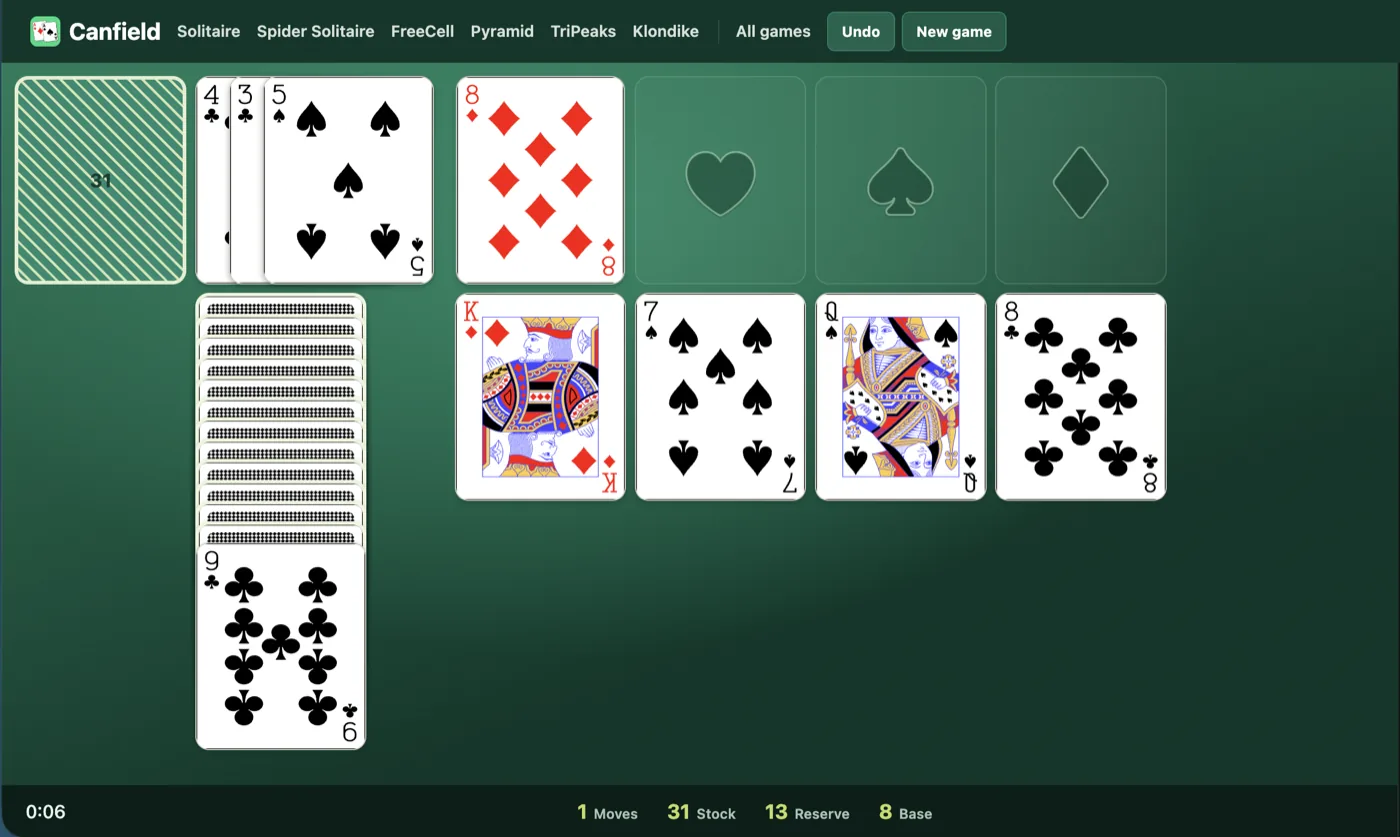
- Reserve: 13 cards (face-down except the playable top).
- Foundations: one face-up base card dealt; three foundations empty (awaiting the same rank).
- Tableau: four face-up starter cards (one per column).
- Stock: remaining 34 cards; draw three; unlimited redeals.
- Waste: filled from the stock in threes.
Rules
- One deck; reserve size 13; four tableau columns.
- Foundation base = dealt rank; build up by suit with wrap.
- Tableau: down by alternating color with wrap.
- Empty tableau columns refill from the reserve.
- Draw count 3; maxRedeals unlimited.
- Win when all 52 cards sit on foundations (4 × 13).
Strategy
Canfield is a race to empty the reserve without stranding the wrapped foundation schedule.
- Know the base rank at all times — every empty foundation wants that card.
- Prioritize the reserve when its top card can move; it gates empty columns and endgame speed.
- Wrapping means sequences like “3-2-A-K-Q” can appear — don’t assume Ace is always “low.”
- Manage the draw-three waste like Klondike Turn 3: only the top card plays.
- Don’t empty a column unless the reserve top (or a planned fill) helps you.
- Use unlimited redeals to dig, but prefer unlocking reserve cards over endless stock churning.
Short prose: Canfield feels small — four columns — but the random base and wrapping turn familiar Klondike instincts sideways. Re-learn where “the bottom” of a suit is each deal.
FAQ
What is the foundation base?
A random rank dealt at setup. Every foundation begins on that rank and builds up by suit, wrapping from King to Ace as needed, until 13 cards are placed.
How does the reserve work?
Thirteen cards sit in the reserve. Only the top is playable. Empty tableau columns refill from the reserve automatically.
Draw three or one?
This table draws three with unlimited redeals.
Do builds wrap?
Yes — both foundations (up by suit) and tableau (down by alternating color) wrap.
Is Auto finish available?
Yes, when the remaining cards can complete safely given the wrapping base.
Can every deal be won?
Not with a pure Random shuffle. Like a physical deck, some layouts simply have no winning line no matter how carefully you play — and that uncertainty is part of the classic challenge. If you would rather spend your time on strategy than on an unlucky seed, open New game and choose Winnable (or Easy, Medium, or Hard). Those options deal from banks of layouts our engine already rated as more promising, so a loss is more often about the moves you made than about an impossible start.
What do the shuffle options mean?
New game offers five deal styles:
- Random — an unbiased fresh seed. Some hands open beautifully; others are dead ends.
- Winnable — a favorable deal drawn from our curated pool, biased toward layouts with clearer progress paths.
- Easy, Medium, and Hard — the same idea, tilted toward gentler, middling, or tougher opening positions.
Your choice sticks for later New games in that browser until you change it.
Trivia
Canfield takes its American name from Richard A. Canfield, the Saratoga casino owner who offered a solitaire challenge as a house game — players bought a deck’s deal and cashed out unfinished cards, a bit of gambling lore attached to an already popular Patience layout. In the UK the same family is often called Demon.
The reserve-plus-random-base design keeps Canfield distinct from Klondike even though both use alternating-color cascades. Online, it’s a favorite “short board” classic with deep tactical wrinkles once wrapping clicks.