Klondike Turn 3
Playable solitaire
Klondike Turn 3
Klondike Turn 3 is classic Klondike with a stricter stock: each deal from the stock turns three cards onto the waste. Only the top card of that waste fan is playable. Everything else matches Turn 1 — alternating-color tableau, Ace-to-King suit foundations, Kings on empty columns, and unlimited recycles — but the three-card rhythm makes timing and waste management the heart of the game.
On SolitaireVP the waste shows a small fan so you can see the cards underneath while you play the top one. When you draw again, new cards reuse the fan slots rather than stretching endlessly to the right. Recycle when the stock empties and continue until the foundations are complete — or until you need Undo to try another line.
Prefer an easier stock? Play Solitaire or Klondike (both draw one).
From New game you can also choose a shuffle style — Random, Winnable, Easy, Medium, or Hard — when you want the next deal to feel more open-ended or more guided.
How to play Klondike Turn 3
- Build foundations up by suit from Ace to King.
- Build the tableau down by alternating color; move single cards or legal face-up runs.
- Place Kings (only) into empty columns.
- Click the stock to draw up to three cards to the waste.
- Play only the top waste card. Cards beneath become available only after the ones above them are moved or after a later recycle reshuffles the order through play.
- Recycle the waste into the stock with unlimited redeals.
- Use Undo and Auto finish as in other Klondike tables.
Setup
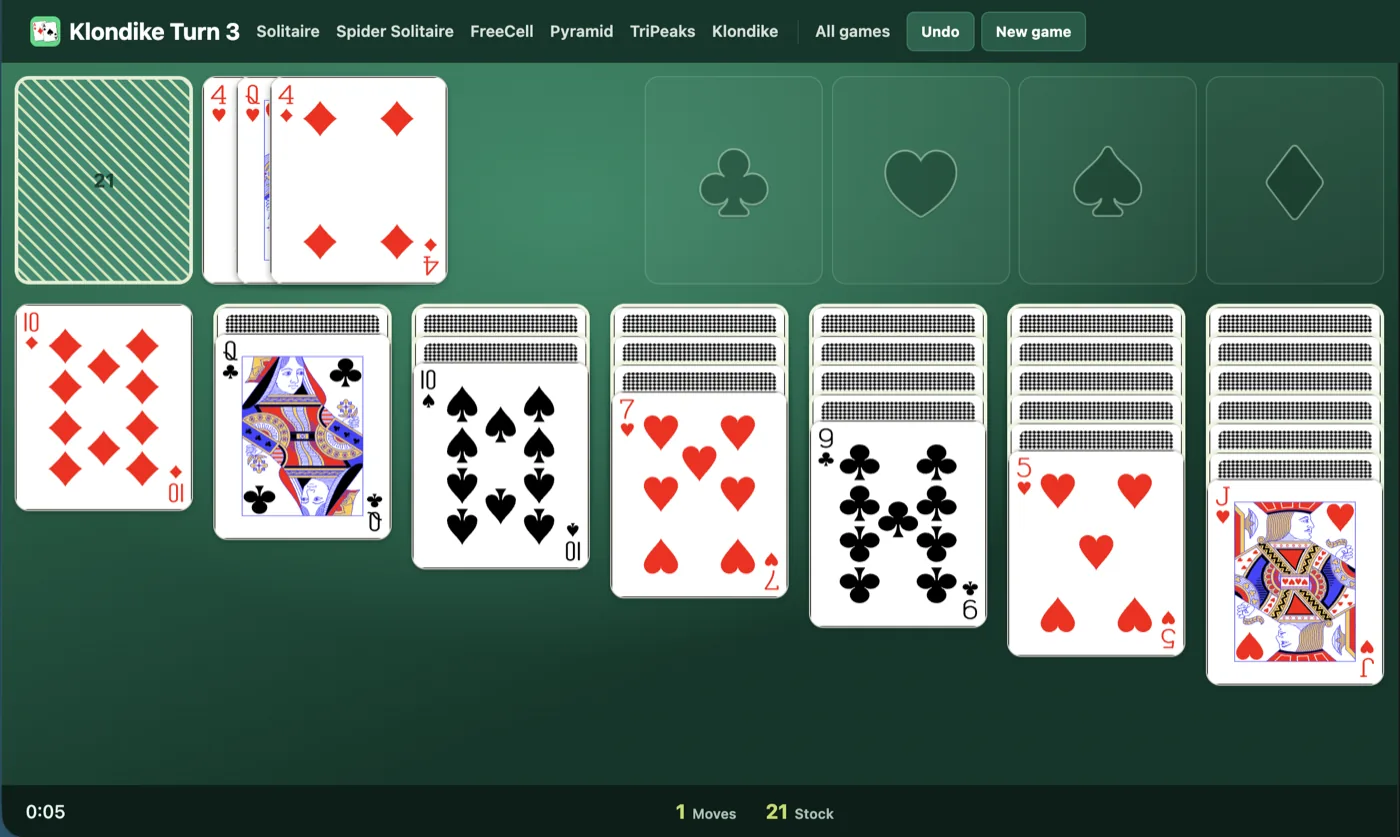
The board deal matches Turn 1 Klondike:
- Seven tableau columns (1…7 cards), tops face-up.
- 24 cards in the stock.
- Empty waste and four empty foundations.
Only the draw rule differs: stock clicks deal three (or fewer if fewer than three remain).
Rules
- One deck; draw count = 3.
- Foundations: Ace → King by suit.
- Tableau: descending, alternating color; Kings fill empty columns.
- Only the top waste card may be played.
- Unlimited stock recycles.
- Win with all 52 cards on foundations.
Strategy
Turn 3 is a waste-fan puzzle. Cards second and third in a triplet are trapped until you clear what sits on them — or until a full recycle brings them around again under a different top card. Plan several stock passes ahead.
- Count availability. Before drawing, know whether the current waste top helps you; don’t churn the stock blindly.
- Prefer flips that free Aces and build helpers you will need when a buried waste card finally surfaces.
- Empty columns remain King-only — don’t open one without a King plan; you have fewer “free” plays than in Turn 1.
- Track suits on foundations so you don’t block a color you still need for tableau weaving.
- Recycle with intention. Each pass changes which card sits on top of each triplet group as cards are removed.
- Undo aggressively. Turn 3 deals punish irreversible early choices; explore, then revert.
Short prose: treat the waste as a queue you can only dequeue from the front. Sometimes the right move is not taking an attractive waste card if doing so buries a critical third card for another full cycle. Patience and pattern memory beat speed.
FAQ
Why is Turn 3 harder than Turn 1?
Because two of every three stock cards are temporarily unplayable. You must clear the waste top (or recycle after many plays) before deeper cards become available, so fewer deals yield to casual play.
Can I see the cards under the waste top?
Yes — SolitaireVP shows a short waste fan for draw-three games so you can plan, even though only the top card is legal to move.
Are redeals limited?
No. You may recycle the waste into the stock unlimited times, same as our Turn 1 Klondike.
Is the tableau different from regular Klondike?
No. Alternating colors, descending ranks, Kings on empty columns — only the stock draw count changes.
Does Auto finish still work?
Yes, when the tableau is fully face-up and the remaining cards can safely finish on the foundations.
Should beginners start here?
Most players learn faster on draw-one Solitaire. Use Turn 3 when you want the classic harder Windows-style challenge.
Can every deal be won?
Not with a pure Random shuffle. Like a physical deck, some layouts simply have no winning line no matter how carefully you play — and that uncertainty is part of the classic challenge. If you would rather spend your time on strategy than on an unlucky seed, open New game and choose Winnable (or Easy, Medium, or Hard). Those options deal from banks of layouts our engine already rated as more promising, so a loss is more often about the moves you made than about an impossible start.
What do the shuffle options mean?
New game offers five deal styles:
- Random — an unbiased fresh seed. Some hands open beautifully; others are dead ends.
- Winnable — a favorable deal drawn from our curated pool, biased toward layouts with clearer progress paths.
- Easy, Medium, and Hard — the same idea, tilted toward gentler, middling, or tougher opening positions.
Your choice sticks for later New games in that browser until you change it.
Trivia
Draw-three Klondike was the default in many printed rule sets and in Microsoft’s Windows Solitaire options, where “Draw Three” became a badge of difficulty. The mechanic echoes older Patience advice: the stock should not hand you every card on demand.
Casino and carnival “Klondike” pitches sometimes limited redeals or charged for another pass through the stock; digital Turn 3 usually keeps unlimited recycles but retains the three-card tension. That balance — tough stock, forgiving redeals — is exactly what SolitaireVP ships here.