Solitaire
Playable solitaire
Solitaire
Solitaire on SolitaireVP is classic Klondike — the Patience layout most people mean when they say “solitaire.” You play with a single 52-card deck. Seven tableau columns start with a cascade of face-down cards topped by one face-up card. Four foundations wait for Aces, then build up by suit to Kings. The remaining cards sit in the stock; you draw one at a time onto the waste, and you may recycle the waste back into the stock as often as you like.
The goal is simple to state and deep to master: clear the tableau and stock by moving every card onto its foundation. Along the way you uncover buried cards, open empty columns for Kings, and decide when to send cards up versus when to keep them working on the board. Click or drag face-up cards; illegal attempts nudge in place. Undo steps back through your history for the current deal, and Auto finish appears when every tableau card is face-up and the rest can safely climb to the foundations.
This is the Turn 1 (draw-one) ruleset — the friendliest Klondike for learning, casual play, and chasing wins. Prefer a harder stock? Try Klondike Turn 3. Want the same rules under the Klondike name? See Klondike Solitaire.
From New game you can also choose a shuffle style — Random, Winnable, Easy, Medium, or Hard — when you want the next deal to feel more open-ended or more guided.
How to play Solitaire
- Foundations — Move Aces onto empty foundation piles, then build each suit Ace → 2 → … → King.
- Tableau — Build down by alternating color (red on black, black on red). You may move a single card or a properly ordered face-up sequence onto a legal target.
- Empty columns — Only a King (or a King-led sequence) may fill an empty tableau column.
- Stock & waste — Click the stock to draw one card to the waste. Play the top waste card when it fits. When the stock is empty, recycle the waste back into the stock — unlimited redeals.
- Flip — When a face-down tableau card is exposed, it flips face-up automatically after legal play.
- Controls — Use Undo anytime. When Auto finish is available, let the game complete the remaining foundation moves with animated flights.
Tap a card to send it to the best available spot (foundations preferred). Or drag stacks yourself for precise play.
Setup
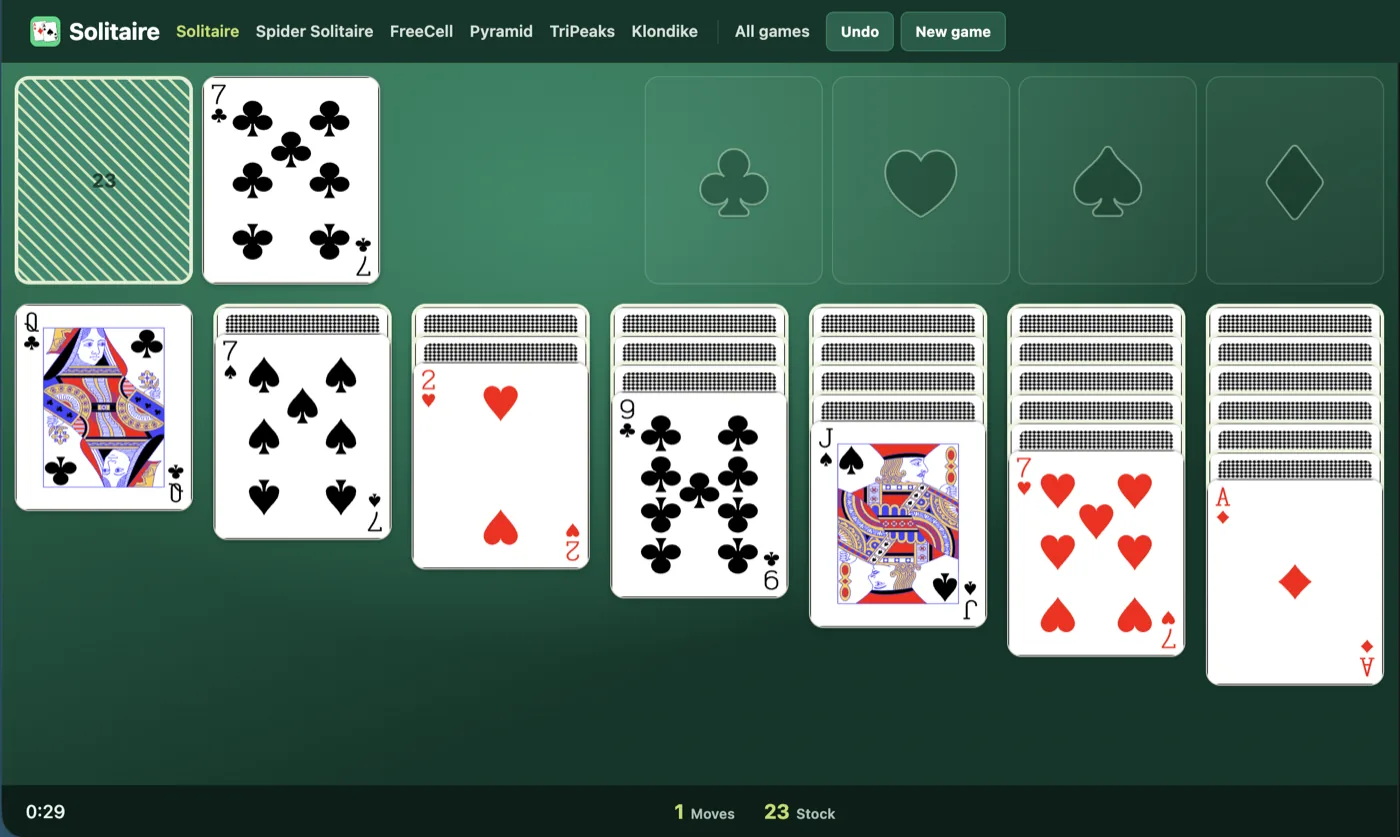
A standard deal looks like this:
- Tableau: seven columns. Column 1 has 1 card, column 2 has 2, … column 7 has 7 — only the top card of each column starts face-up (28 cards total on the board).
- Stock: the remaining 24 cards, face-down.
- Waste: empty at the start.
- Foundations: four empty piles (one per suit), filled Ace through King.
Rules
- One 52-card deck; draw one from the stock each time.
- Foundations build up by suit from Ace to King.
- Tableau builds down by alternating color.
- Empty tableau columns accept Kings only (or King-led runs).
- You may move any contiguous face-up descending alternating-color sequence as a unit.
- Unlimited stock recycles (redeals).
- Cards already on foundations may not be pulled back down in this ruleset’s normal play path once Auto finish / win path is underway; play to foundations carefully.
- Win when all four foundations hold complete Ace–King runs (52 cards home).
Strategy
Klondike rewards patience more than speed. Every face-down card you expose increases your options; every empty column you open is a powerful “parking” space — but only Kings can use it, so don’t empty a column unless you have a King ready or a clear plan.
- Expose face-down cards early. Prefer moves that flip buried cards over cosmetic rearrangements.
- Don’t rush Aces and Deuces — send low cards up when it unlocks the tableau, but keep mid-rank helpers on the board if they still build useful sequences.
- Empty columns are precious. Save them for Kings; avoid stranding yourself with no King to place.
- Watch the waste. With draw one, every stock card becomes playable in turn — still plan ahead so you don’t bury a key card under a long recycle.
- Build evenly across suits when possible so Auto finish becomes available sooner.
- Undo is a learning tool. Explore a line, then step back if it dead-ends.
Short prose tip: think in “reveals.” If two moves are legal, choose the one that flips a card or frees a King. Foundations are the finish line, not the only scoreboard — a tidy alternating cascade that opens the next face-down card usually beats an early foundation move that locks a color you still need on the tableau.
FAQ
Is Solitaire the same as Klondike?
Yes. On SolitaireVP, Solitaire is classic Klondike with draw one and unlimited redeals — the same family as Windows Solitaire and most “play solitaire online” sites.
What is the difference between Turn 1 and Turn 3?
Turn 1 (this page) draws one card from the stock to the waste each click. Turn 3 draws three; only the top waste card is playable, so many stock cards cycle past before you can use them. Turn 1 is generally easier and more winnable; Turn 3 is the classic harder challenge.
How often is Klondike winnable?
Not every random deal can be won even with perfect play — estimates for draw-one with unlimited redeals often land well above half of deals being solvable in principle, but real win rates depend on skill and how aggressively you explore lines. Draw-three deals are notably harder. Prefer fewer dead-end starts? Use New game → Winnable or Easy (see the shuffle FAQs below). Undo still lets you explore lines on the same deal.
Can I undo a move?
Yes. Undo steps back through your move history for the current deal so you can try another line without starting over.
When does Auto finish appear?
When every tableau card is face-up and the remaining cards can safely go to the foundations, Auto finish becomes available. It then plays the foundation sequence for you with card flights.
Do I have to build by suit on the tableau?
No. The tableau builds by alternating color and descending rank. Suit matching is only required on the foundations.
Can I play on mobile?
Yes. The board is responsive; tap to move or drag cards. The same Turn 1 Klondike rules apply on phone and desktop.
Can every deal be won?
Not with a pure Random shuffle. Like a physical deck, some layouts simply have no winning line no matter how carefully you play — and that uncertainty is part of the classic challenge. If you would rather spend your time on strategy than on an unlucky seed, open New game and choose Winnable (or Easy, Medium, or Hard). Those options deal from banks of layouts our engine already rated as more promising, so a loss is more often about the moves you made than about an impossible start.
What do the shuffle options mean?
New game offers five deal styles:
- Random — an unbiased fresh seed. Some hands open beautifully; others are dead ends.
- Winnable — a favorable deal drawn from our curated pool, biased toward layouts with clearer progress paths.
- Easy, Medium, and Hard — the same idea, tilted toward gentler, middling, or tougher opening positions.
Your choice sticks for later New games in that browser until you change it.
Trivia
Patience — the British name for solitaire card games — flourished in the eighteenth and nineteenth centuries as a quiet single-player pastime. Dozens of layouts appeared in books long before digital versions: adding games, building games, and packing games that taught pattern recognition and planning.
Klondike became the dominant North American form of “solitaire.” Its name evokes the Klondike Gold Rush, and by the early twentieth century the seven-column Ace-to-King layout was the version most households recognized. Magazines and rule pamphlets cemented draw-one and draw-three variants; casinos and carnivals sometimes offered “Demon” or Canfield-style side attractions, but Klondike stayed the living-room standard.
When Microsoft bundled Solitaire with Windows 3.0 in 1990, Klondike reached hundreds of millions of players overnight. The familiar green felt, cascading tableau, and addictive “just one more deal” loop made it one of the most played computer games in history — and the template every free online solitaire site still follows. SolitaireVP’s homepage game is that same classic: draw one, unlimited redeals, foundations by suit, tableau by color.